


Short answer: For most bathrooms, porcelain is the safer choice on floors and in showers, and ceramic works well on walls. Porcelain is a type of ceramic tile that absorbs very little water. Under the ANSI A137.1 tile standard, porcelain is a ceramic tile with water absorption of 0.5 percent or less (ANSI). Regular ceramic tile absorbs more. Either can look good. The differences show up in how they wear, how they cut and how they are rated for wet floors. Natural stone is a third choice that looks different and needs more care.
This guide compares the three, explains the slip rating you should look for, and suggests a tile for each part of the room.

What is the difference between porcelain and ceramic tile?
Both are made from clay, shaped and fired. The key difference is density.
- Porcelain is fired to be dense. By the ANSI A137.1 definition, it absorbs 0.5 percent or less water by weight, measured under ASTM C373 (ASTM). Only tiles that meet that number can be called porcelain under the industry’s certification program.
- Ceramic (non-porcelain) tile absorbs more water. It is usually softer, easier to cut and lighter.
Two things get confused:
- “Porcelain” is a ceramic. Porcelain is a variant of ceramic tile, so the real comparison is porcelain against non-porcelain ceramic.
- Low absorption does not make a shower waterproof. The tile can resist water, but the grout and the setting materials behind it do not. A shower still needs a waterproofing layer behind the tile. See shower waterproofing.
Porcelain vs. ceramic vs. natural stone at a glance
| Porcelain | Ceramic (non-porcelain) | Natural stone (marble, limestone, travertine, slate) | |
|---|---|---|---|
| Water absorption | 0.5% or less by definition | Higher than porcelain | Varies by stone; many are porous |
| Where it works | Floors, shower floors, walls, wet areas | Walls, backsplash, low-traffic floors | Floors and walls with sealing and care |
| Cutting and install | Harder and denser, so harder to cut | Easier to cut | Needs careful handling; some stones are soft |
| Upkeep | Low. Grout needs cleaning | Low. Surface glaze can chip | Needs sealing and the right cleaners |
| Look | Wide range, including stone and wood looks | Wide range of color and finish | Real variation from piece to piece |
| Main risk | Slick if the finish is polished | Chips show a different color underneath on some glazed tile | Etching and staining |
Treat the table as a starting point. Individual tile lines differ, so always check the product’s own rating.
Where porcelain is the better choice
Floors. Bathroom floors get water and foot traffic. Porcelain is dense and hard wearing, so it holds up there.
Shower floors and wet zones. Low absorption plus a wet slip rating is the combination to look for.
Large-format tile. Many large-format tiles are porcelain. Large tile means fewer grout lines, but the substrate must be flat. See the note on installation below.
Heated floors. Many porcelain tiles are used over radiant heat. Follow both the tile maker and the heating system maker.
Where ceramic is the better choice
Walls. Walls do not take foot traffic, so a softer tile is fine. Ceramic wall tile is often easier to cut around niches and outlets, and many shapes and glazes are made as wall tile only.
Backsplashes and accents. Handmade-look or glossy ceramic gives a deeper color.
Wall-only styles. Many shapes and glazes are made for walls only, and a showroom visit shows what is available.
Check the box. Some ceramic tile is rated for walls only. Putting it on a floor can lead to chips and wear.
Slip resistance: what to look for on the box
If you only check one rating for a bathroom floor, make it this one.
The ANSI A326.3 test measures a tile’s dynamic coefficient of friction (DCOF) when wet. For level interior wet areas, the standard sets a wet DCOF of 0.42 or higher, unless the manufacturer declares otherwise. This criterion has carried across editions of the standard (Qualicer paper).
Points to keep in mind:
- 0.42 is a benchmark, not a guarantee. Manufacturers say no floor tile is slip-proof (Daltile).
- Finish matters. A polished tile tends to be slicker than a matte or textured one. Look at the rating, not the look.
- Size matters too. Tile size can affect wet slip resistance (Daltile). Smaller tile means more grout lines and more traction underfoot.
- Shower floors and bathroom floors are different jobs. A shower floor stays wet more of the time. Choose a texture or a smaller tile for it.
- Cleaners and wear change the result. The test compares tile as manufactured. A floor can get slicker with soap film or worn glaze.
Ask for the DCOF number on any floor tile you are considering. Our team can pull the spec sheet for you.
Natural stone in a bathroom
Marble, limestone, travertine and slate have a look you cannot copy exactly. They also come with upkeep.
- Porosity. Natural stone is porous and usually needs a penetrating sealer. Sealing helps protect against stains, but it does not make stone stain-proof. A sealer repels liquid more than it truly seals the stone (Daltile care guide).
- Acid etching. Marble, limestone and travertine react to acids, even mild household ones such as vinegar or lemon juice. Many bathroom, grout and tub-and-tile cleaners contain acid, and care guides advise against them on these stones.
- Grout. Care guides suggest non-sanded grout with polished marble and limestone, since sanded grout can scratch the surface.
- Variation. The tile in the box will not match the sample exactly. That is part of the appeal.
- Wet floors. Ask about slip resistance for the exact stone and finish. A honed finish is usually less slick than a polished one.
If you love stone but do not want the care, many porcelain tiles are made to look like stone. See them in person, because printed patterns vary from tile to tile in different ways.
Related: Modern Bathroom Tiles · 5 Stylish Bathroom Shower Tile Ideas
Grout and upkeep, whatever tile you choose
Grout is the part of a tiled bathroom that needs the most attention. It is porous, it stains, and it can crack where surfaces meet. Wipe the shower walls after use, clean grout lines on a schedule, and replace caulk at corners and edges when it splits. Tile choice changes how often you do this. Smaller tile and wider joints mean more grout to clean. Large tile with narrow joints means less.
A tile for each part of the room
| Surface | Good fit | What to check |
|---|---|---|
| Bathroom floor | Porcelain with a wet slip rating | DCOF on the spec sheet, finish |
| Shower floor | Porcelain, small format or textured | Slip rating, size, slope to the drain |
| Shower walls | Porcelain or ceramic | Rated for wet use; a membrane behind the tile |
| Walls outside the shower | Ceramic or porcelain | Wall-only rating is fine |
| Tub surround | Ceramic or porcelain | Waterproofing behind the tile |
| Natural stone anywhere | Only if you will seal and care for it | Sealer, cleaners, etching |
Installation matters as much as the tile
A good tile can fail under a bad setting. Three points to ask about:
- Flat substrate. Large tile shows every dip. The floor or wall needs to be flat to the tile maker’s tolerance.
- Right mortar. Large and heavy tiles need the right setting material and full coverage.
- Waterproofing. In a shower, the tile is not the waterproofing. A membrane behind it is.
Our in-house installers set the tile, with a dedicated project manager on your project. We do not use subcontracted crews.
How to choose, step by step
- Decide the use. Floor, shower floor, wall or accent.
- Set the slip rating. Ask for the wet DCOF on any floor tile.
- Pick a size. Small for shower floors, large for fewer grout lines on walls and floors.
- Pick a finish. Matte or textured on floors, any finish on walls.
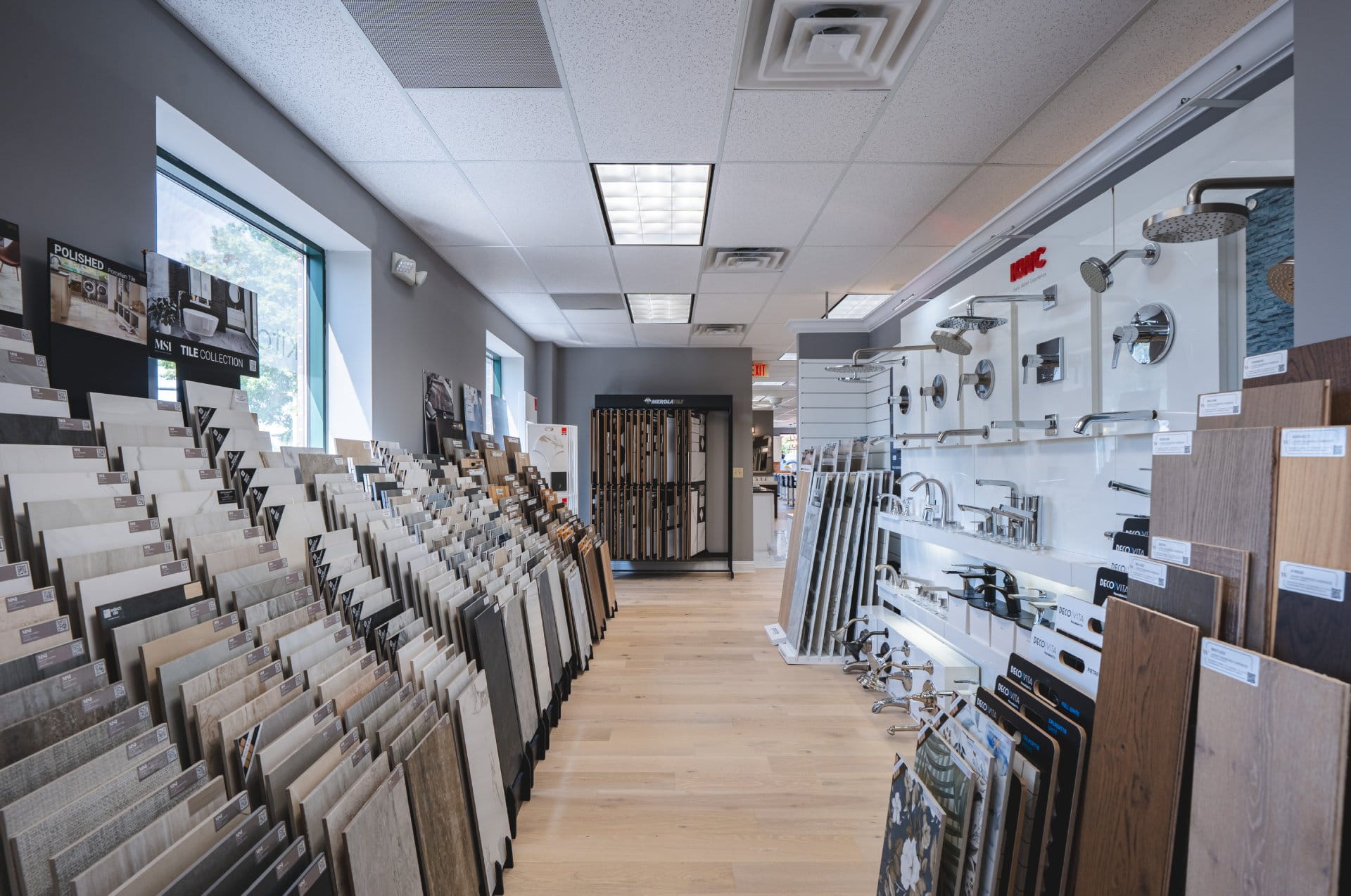
- See it in person. Look at tile in your own light. Our showroom has tile next to cabinets, countertops and bathroom vanities so you can see the combination.
FAQ
Is porcelain tile better than ceramic for a bathroom?
For floors and showers, usually yes. Porcelain is denser and absorbs 0.5 percent or less water by definition. Ceramic works well on walls. The best choice depends on the surface and on the specific tile’s rating.
What is the difference between porcelain and ceramic tile?
Porcelain is a type of ceramic tile that meets a water absorption of 0.5 percent or less under the ANSI A137.1 standard. Other ceramic tile absorbs more water, is often softer and is easier to cut.
What DCOF rating should bathroom floor tile have?
For level interior wet areas, the ANSI A326.3 standard sets a wet DCOF of 0.42 or higher, unless the manufacturer declares otherwise. Ask for the number on the spec sheet. No tile is slip-proof, and finish and size both affect how a wet floor feels.
Is natural stone a good choice for a shower?
It can be, with care. Stone is porous and often needs sealing. Marble, limestone and travertine can etch from acidic cleaners. If you want the look without the care, a porcelain tile made to look like stone is an alternative.
Can I use the same tile on the floor and the walls?
Often yes, if it is rated for floors. A floor-rated porcelain works on walls. Wall-only tile should not go on a floor. Check the box and the spec sheet.
See tile in person
We can help you narrow the choices by surface, rating and style. Our bathroom remodeling process includes design, so selections are made with the plan in front of you. See our process, then visit the showroom at 3204 Old Pickett Rd, Fairfax, VA 22031, call (703) 552-5252, or book a free design consultation. Hours are Monday through Friday, 9:00 a.m. to 5:00 p.m., and Saturday, 10:00 a.m. to 4:00 p.m. We serve Fairfax, Vienna, Oakton, Burke, Springfield, Annandale, Falls Church, McLean, Reston, Chantilly, Centreville and nearby communities.
City Kitchen & Bath is licensed (Virginia Class A license 2705185680) and insured. Standards information is general and was current as of November 2026. Always check the manufacturer’s rating and installation instructions for the specific tile.
