


Short answer: Tile and grout do not keep water out of a shower wall or floor. A waterproof membrane behind or under the tile does. The membrane has to cover the whole wet area, tie into the drain, and be sealed at every seam, corner and penetration. Most shower failures trace back to a gap in that layer, a shower floor that does not slope, or a drain that was not connected properly. A flood test before tile goes on is how you find out.
This guide explains what the membrane is, the main types, the places where showers leak, and the questions to ask before you hire anyone to build one.
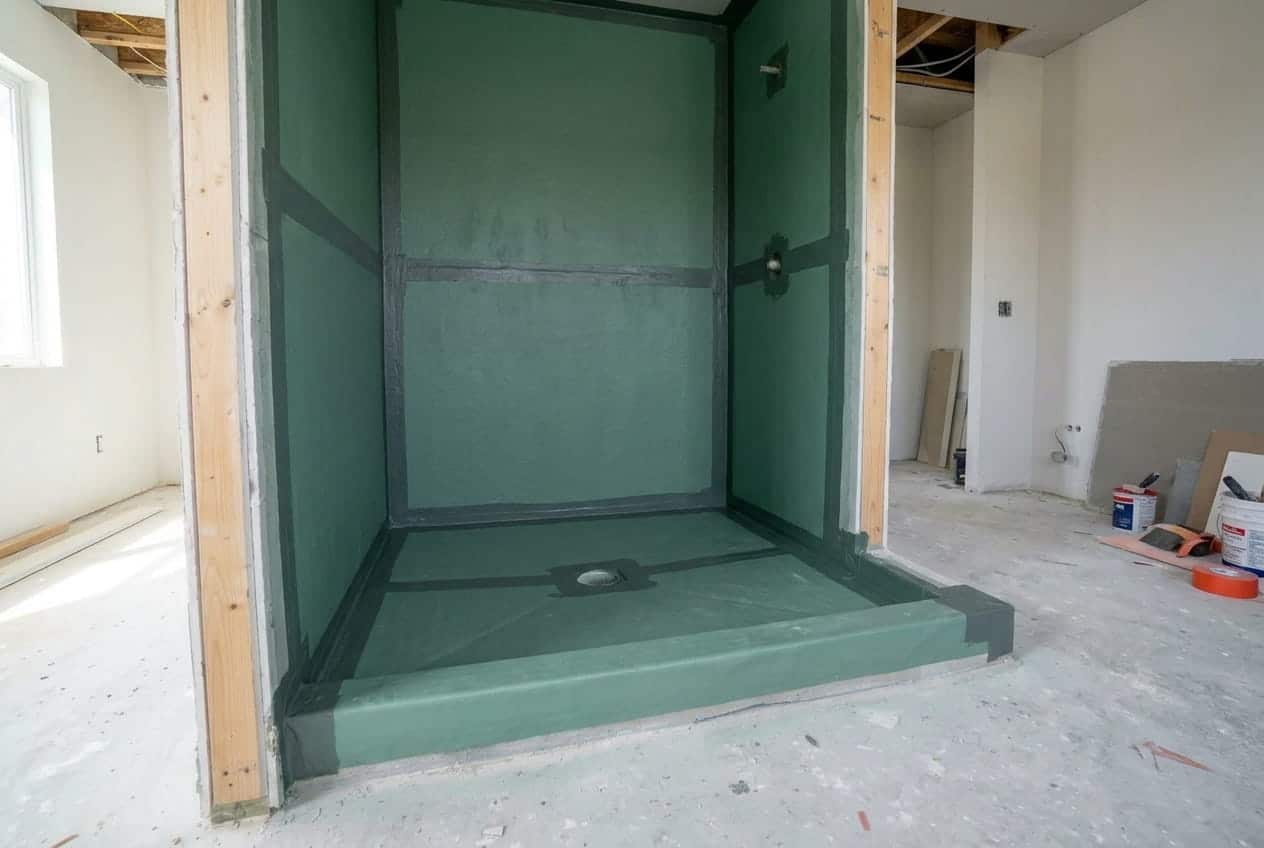
Why tile is not waterproof
Tile is hard, but the joints between tiles are grout, and grout is porous and can crack. Even dense tile only slows water. The ANSI standard for ceramic tile classifies tile by how much water it absorbs, because ceramic tile is not inherently waterproof (ANSI). Water gets through grout, sits behind the tile and soaks whatever is there.
If that is drywall or wood, the result is rot and mold. If it is a mortar bed with no membrane, it holds water against the framing. A tile shower works because a waterproof layer sends water down to the drain.
What is a shower waterproofing membrane?
A membrane is a continuous waterproof layer between the tile and the structure. Waterproof membranes used in tile showers are expected to meet ANSI A118.10, the standard for load bearing, bonded, waterproof membranes. The Tile Council of North America (TCNA) handbook details that use a membrane call for one that meets it, according to the product evaluation reports we reviewed (ICC-ES). Look for A118.10 in the product’s data sheet.
Three things to know about the standard and the label:
- A118.10 covers waterproofing and strength. It tests that the membrane holds up under load, not just that it keeps water out.
- Editions change. The current edition appears to be A118.10-2023, though some makers still cite older ones. Ask which edition the product meets.
- Steam is different. A118.10 alone is not enough for a steam shower. Vapor transmission has to be considered separately, and one membrane maker says a continuous-use steam shower needs a membrane rated at 0.5 perms or less when tested to ASTM E96 (manufacturer literature, not a code rule). Follow the maker’s instructions for steam.
Types of shower waterproofing
| Type | What it is | Strengths | Watch for |
|---|---|---|---|
| Sheet membrane | A thin sheet bonded to the surface with thin-set mortar, with sealed seams | Consistent thickness; the installer can see the layer | Every seam, corner and penetration must be sealed |
| Liquid-applied membrane | A paint-on or roll-on coating that cures into a waterproof film | Covers odd shapes; no sheet seams | Needs the correct thickness and full cure time; the maker’s coverage and cure rules apply |
| Foam board with laminated membrane | Rigid foam panel with a membrane on the face | Fast and flat; seams are sealed with a matching product | Fasteners, joints and edges must be sealed as the maker specifies |
| Traditional pan liner | A sheet liner under a mortar bed that drains through a clamping drain | A proven older method | Needs a second slope under the liner and weep protection at the drain |
Each type works when it is installed the way the maker and the TCNA handbook describe. None is a magic fix. The installer matters more than the brand.
Is cement board waterproof?
No, not on its own. Cement backer board holds up when wet, but water passes through it. TCNA guidance says a waterproof membrane or vapor retarder should be specified to protect adjacent materials (DIY Tile Guy, quoting the TCNA handbook). Some boards are sold with the membrane built in or as “waterproof” boards. Even those may need extra treatment in certain areas, such as shower pans. Read the maker’s instructions for the exact product.
How the layers go together
A typical tile shower is built from the bottom up like this:
- Framing and blocking. Solid framing, with blocking where a bench, niche or grab bar will go.
- Pre-slope. A sloped base under the membrane that directs water to the drain. This is done before waterproofing, not just in the mortar on top.
- Drain. A two-stage drain, with a weep protection so that water that gets under the tile can still reach the drain.
- Membrane. Applied over the sloped base, up the walls and tied into the drain flange.
- Backer or substrate on the walls. Cement board, foam board or another approved base.
- Tile and grout. The wear surface.
- Sealant at changes of plane. Flexible caulk at corners, not grout.
A detail sheet for a curbless shower from the Installation Masters Institute shows this pattern: a sloped mortar bed, a bonded waterproof membrane and a two-stage drain (IMI). Check the current TCNA Handbook for the exact method used on your job.
Where showers fail
Most leaks are not a wall full of water. They are a small gap that lets in a little water for a long time. The common weak points:
- No membrane at all. Older showers were often tiled over mortar or board only.
- Missing coverage. The membrane stops short of the top of the wall, or does not cover the whole floor.
- Seams and corners. Where one piece meets another, a gap forms. These need reinforcing and sealing.
- Fasteners and penetrations. Every screw, pipe and valve is a hole in the layer. Each needs sealing.
- The drain. A drain that is not tied into the membrane, or a clamping ring that is not tight, lets water around it. A drain with blocked weep holes holds water under the tile.
- No pre-slope. Slope only on top of the membrane leaves a flat membrane that holds water.
- Curbs, benches and niches. Extra surfaces and corners are the hardest to wrap. They need the same continuous coverage.
- Cracks from movement. Where the shower meets another surface, the joint should be flexible, not rigid grout.
- Poor curing. Liquid membranes applied too thin or tiled before they cure.
- Skipped test. If no one tests it, no one knows.
A source that surveys common shower waterproofing errors lists the failure to pre-slope and unprotected weep holes among the most common ones (Construction Canada). We could not verify the full article text, so we cite it only for those two points.
Related: What Are the Most Common Challenges in Bathroom Remodeling? · The Complete Manual for Walk-In Shower
The flood test
A flood test is the simplest proof that a shower pan is watertight, and it is done before tile goes on.
How it works:
- Plug the drain and fill the shower floor with water, below the top of the curb.
- Mark the water line.
- Leave it for the required time.
- Check that the level has not dropped and nothing leaks below.
How long? Sources vary. Many guides put it at about 24 hours, and one Minnesota state document requires a depth of at least 2 inches held long enough to establish watertightness, which it puts at 24 hours (Minnesota DLI). Some manufacturers and local inspectors set different times. Follow the membrane maker’s instructions and the local inspector. Liquid membranes must be fully cured before testing.
Ask any contractor three questions: Do you flood test every shower? For how long? Can I see it? We recommend you see the water line yourself.
Walls, niches and benches
The floor gets the most attention, but walls leak too.
- Walls. The membrane should cover the wall area that gets wet. Where it stops depends on the shower design, the glass and the maker’s instructions. Ask where it ends.
- Niches. A recessed shelf is a box with many corners. Use a pre-made waterproof niche or wrap it like the rest of the shower, and slope the shelf slightly so water does not pool.
- Benches. The seat should slope slightly toward the shower floor and be fully wrapped.
- Valve and shower arm. Seal around the pipes where they come through the wall.
- Glass. Shower glass is often fastened to tile. Use sealant at the holes. See our shower door options.
What about the bathroom floor outside the shower?
Some designs, especially curbless showers, extend waterproofing past the shower so water that escapes is still contained. That is a design decision. See curbless showers in older homes.
How to tell if your existing shower is failing
- Cracked, loose or hollow-sounding tile
- Grout that keeps staining or crumbling
- Soft or stained drywall on the other side of the shower wall
- A musty smell in the bathroom or the room next door
- Staining on the ceiling below the bathroom
- Water that does not drain, or a shower floor that stays damp
These signs do not always mean the membrane failed. Sometimes it is a grout or caulk problem. A contractor who opens a small area can tell you. If water damage has reached the framing, repair is part of the project.
Permits and inspections
This is general information, not legal advice. Fairfax County lists new, repaired or relocated plumbing fixtures, including showers, and bathroom remodels as work that needs a permit (Fairfax County). Whether a shower pan inspection is part of the process depends on the work and the inspector. We handle permits for our projects.
What to ask a contractor before they build a shower
- Which waterproofing system do you use, and does it meet ANSI A118.10?
- Is the floor pre-sloped before the membrane goes on?
- How are the drain, seams, corners and penetrations sealed?
- Do you flood test, and for how long?
- Who does the work? We use in-house installers, not subcontracted crews.
- What is the workmanship warranty? Ours is a 5-year workmanship warranty.
A bathroom remodeler who answers these clearly knows the work. Our typical bathroom remodel takes 2 to 4 weeks of construction, and the waterproofing and test happen before tile starts.
FAQ
Is tile waterproof?
No. Tile resists water, but grout is porous and joints can crack. A shower needs a waterproof membrane behind or under the tile to keep water out of the wall and floor.
What is ANSI A118.10?
It is the American National Standard for load bearing, bonded, waterproof membranes used under tile. Membranes in tile showers are expected to meet it. For steam showers, vapor transmission must be checked as well.
Is cement board waterproof?
Not by itself. It tolerates moisture, but water passes through. It needs a membrane or a waterproofing system designed for it. Follow the maker’s instructions for the board you use.
Do I need a flood test on a new shower?
It is the best proof of a watertight pan. Many local codes and manufacturers call for it, with about 24 hours a common time. Ask your contractor to do it before tile, and check the water line yourself.
Which waterproofing is better, sheet or liquid?
Both work when installed correctly. Sheet gives uniform thickness. Liquid covers odd shapes with no seams. The details of installation matter more than the type. Ask what your contractor uses and why.
How long should a tiled shower last?
A properly built shower can last many years. We do not have a verified lifespan figure, so we will not quote one. Maintenance matters: keep the grout and caulk sound and re-caulk when it fails. Our work carries a 5-year workmanship warranty.
Build it right the first time
A shower is only as good as the layer you cannot see. We design and build showers with in-house installers and a dedicated project manager. See our process, browse tile in our showroom at 3204 Old Pickett Rd, Fairfax, VA 22031, call (703) 552-5252, or book a free design consultation. Hours are Monday through Friday, 9:00 a.m. to 5:00 p.m., and Saturday, 10:00 a.m. to 4:00 p.m. We serve Fairfax, Vienna, Oakton, Burke, Springfield, Annandale, Falls Church, McLean, Reston, Chantilly, Centreville and nearby communities.
City Kitchen & Bath is licensed (Virginia Class A license 2705185680) and insured. Standards and permit information is general, not legal advice, and was current as of November 2026. Always follow the membrane maker’s instructions and your local inspector.
