


Short answer: For a bathroom of 100 square feet or less, the Home Ventilating Institute (HVI) recommends a fan that moves about 1 cubic foot per minute (CFM) for each square foot of floor, which is roughly eight air changes an hour (HVI). The model residential code sets a floor of 50 CFM for a fan that runs on a switch, or 20 CFM for one that runs continuously (IRC R303.3 summary). In practice, buy a fan that is rated for the room, install it with a short, straight duct to the outdoors, and run it long enough to clear the steam. A good fan on a bad duct will not do the job.
This guide covers the sizing math, what the code says, how ducting affects real airflow, and how to use the fan to prevent mold.

Why bathroom ventilation matters
Showers put a lot of moisture in the air. If it stays there, it condenses on cold surfaces, soaks paint and drywall, and feeds mold. The EPA says to keep indoor humidity below 60 percent, ideally between 30 and 50 percent (EPA). It also advises running the bathroom fan or opening a window while you shower, and venting bathroom fans outdoors, not into the attic (EPA).
A fan is also part of protecting the work in a remodel. New tile, paint and a vanity last longer in a room that dries. That is why a fan upgrade often belongs in a bathroom contractor’s scope, even when the homeowner did not ask for it.
How to size a bathroom exhaust fan
Bathrooms 100 square feet or smaller
HVI’s guidance is to match the fan to the floor area: 1 CFM per square foot. HVI’s example is an 8 by 5 foot bathroom (40 square feet), which needs a fan rated for at least 40 CFM (HVI).
The math:
- Measure length times width in feet.
- That number is your minimum CFM.
- Round up to the next common size, and never go below the code minimum of 50 CFM.
HVI’s own page gives a 40 CFM example, while the code floor is 50 CFM. For a typical small bath, the code floor is the number that controls. Retail guides also suggest going up a size when the room is near a threshold. That advice comes from manufacturers and sellers, not from HVI.
| Bathroom size | HVI 1 CFM per sq ft | Practical minimum |
|---|---|---|
| 5 x 8 ft (40 sq ft) | 40 CFM | 50 CFM (code floor) |
| 6 x 9 ft (54 sq ft) | 54 CFM | 54 CFM or more |
| 8 x 10 ft (80 sq ft) | 80 CFM | 80 CFM or more |
| 10 x 10 ft (100 sq ft) | 100 CFM | 100 CFM or more |
Bathrooms over 100 square feet
For larger rooms, HVI switches to counting fixtures: 50 CFM each for a toilet, a shower or a standard tub, and 100 CFM for a jetted tub. A bathroom with a tub, a shower and a toilet adds up to 150 CFM. That can be met by one 150 CFM fan or by three 50 CFM fans, one at each fixture (HVI).
Tall ceilings
The 1 CFM per square foot rule assumes a standard ceiling height. A taller room holds more air, so it needs more airflow. A volume method (floor area times ceiling height, divided by 60 and multiplied by 8 air changes) gives a higher number for a tall room. If your ceiling is above 8 feet, ask your contractor to run the numbers. We do not have an HVI table for this, so treat it as general guidance.
Steam showers
HVI says a steam shower should have its own fan in the steam room (HVI). Steam rooms also need a vapor-resistant membrane. See shower waterproofing.
What does the code say?
This is general information, not legal advice. Check the edition your jurisdiction uses.
- Capacity. The model International Residential Code (IRC) requires a bathroom without an openable window to have mechanical exhaust, at 50 CFM if it runs intermittently or 20 CFM if it runs continuously. The fan must be HVI listed, according to the summary at Jaspector. That site is a third-party summary of the code, not the code text.
- Window option. A bathroom with a compliant openable window can skip the fan, but a fan is still a good idea in a bathroom with a shower.
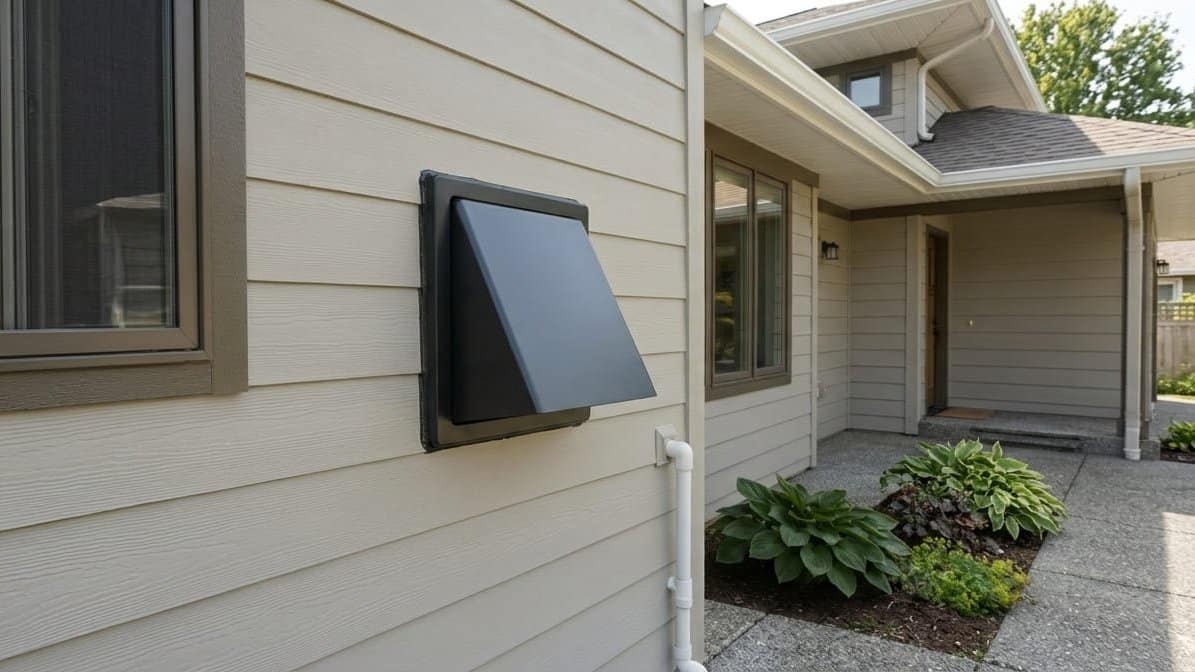
- Where it goes. The exhaust must discharge directly to the outdoors. It cannot end in an attic, crawlspace, garage or other interior space. The outdoor cap should have a backdraft damper.
- Virginia. Virginia’s building code is the 2021 edition, effective January 18, 2024 (Virginia DHCD). It is based on the 2021 model codes, with Virginia changes. The IRC 2021 bathroom rate is the same 50 and 20 CFM in the summaries we checked, but read the adopted Virginia text or ask the county to confirm.
- Permits. Fairfax County lists bathroom remodels among interior renovations that need a permit (Fairfax County). We handle permits for our projects.
Why ducting matters as much as CFM
A fan’s rating is measured in free air. Once it pushes through a duct, the airflow drops. Long runs, tight bends and flexible foil duct all add resistance. One summary of the code says a fan rated at 50 CFM can deliver as little as 30 to 35 CFM at the end of a 20-foot run with two elbows. We could not confirm that figure from a primary source, so treat it as an example of the effect, not a rule.
What helps:
- Short and straight. Keep the duct as short as possible, with few bends.
- Smooth duct. Rigid or smooth-wall duct moves air better than crushed flexible duct.
- Insulated duct in attics. A cold duct causes condensation, which drips back toward the fan. Insulating it prevents that.
- Slope to the outside. The duct should not trap water. Follow the fan maker’s instructions.
- Right duct size. Use the duct diameter the fan maker specifies. Do not shrink it.
- A real termination. Many older houses were built with bathroom fans that blow into the attic. That moves the moisture to a place where it can rot framing and grow mold. The fix is a duct to a roof or wall cap, with a damper.
- Not a soffit. Moist air can be drawn back into the attic through a nearby soffit vent. The Jaspector summary advises against terminating in a soffit or within 3 feet of a building opening.
For a long run or many elbows, the same summary suggests choosing a fan with a higher CFM rating, in the range of 80 to 110 CFM. That is contractor guidance, not a code rule. The better answer is a shorter duct.
Fan features worth having
- HVI listing. Look for the HVI certified rating on the box. The code asks for a listed fan, and manufacturer-only ratings do not count.
- Sound rating. Fans are rated in sones. A quiet fan gets used. A loud one gets switched off.
- Humidity sensor or timer. The fan runs while the room is damp and turns off by itself. That saves you from remembering.
- Light combination. Many fans include a light, handy over a shower. Check that the light is rated for wet locations if it is over the shower.
- Replacement housings. Some fans are made to replace an old unit without opening the ceiling.
How to use the fan to prevent mold
A fan only helps if it runs.
- Run it during the shower and for about 20 minutes after. HVI suggests about 20 minutes and recommends a timer (HVI).
- Let air in. The fan pulls air from somewhere. HVI suggests undercutting the bathroom door so makeup air can enter.
- Keep the fan clean. Dust on the grille and blades cuts airflow. Clean it a couple of times a year.
- Watch for signs. Peeling paint, a musty smell, spotting on the ceiling or fogged mirrors that stay fogged are signs the fan is not keeping up.
- Dry wet areas fast. The EPA says to dry water-damaged areas within 24 to 48 hours to prevent mold growth (EPA).
Related: Bathroom Lighting Ideas · Shower Waterproofing: What Goes Behind the Tile
What we check on a bathroom remodel
When we plan a bathroom, ventilation is part of the walk-through.
- Size the fan to the room and the fixtures.
- Look at where the old duct goes. Is it connected, and does it reach the outdoors?
- Plan the shortest route to a wall or roof cap.
- Specify an HVI-listed fan with a sound rating that suits the room.
- Confirm the work with the inspector when a permit is required.
Our typical bathroom remodel takes 2 to 4 weeks of construction, and ventilation is planned in design, before the ceiling closes.
FAQ
What size exhaust fan do I need for a bathroom?
For a bathroom of 100 square feet or less, HVI recommends 1 CFM per square foot, and the model residential code sets a minimum of 50 CFM for an intermittent fan. For most small bathrooms, a fan of 50 CFM or more is the starting point.
Is 50 CFM enough for a bathroom fan?
For a small bathroom with a short duct, yes. A 50 CFM rating is the code minimum and usually works for rooms up to about 50 square feet. Longer duct runs reduce real airflow, so a larger fan or a shorter duct may be needed.
Can a bathroom exhaust fan vent into the attic?
No. The model code requires the exhaust to discharge directly to the outdoors, and the EPA advises venting bathroom fans outside, not into the attic. Venting into an attic puts moisture where it can cause mold and damage.
How long should I run the bathroom fan after a shower?
About 20 minutes, according to HVI, with a timer if you want it automatic. Longer is fine if the room stays damp.
Do I need a bathroom fan if I have a window?
The model code allows an openable window of the required size in place of a fan. A fan still works better, since you can run it when the window is shut in winter. Many people choose both.
Can the bathroom fan duct be as long as I like?
No. Longer runs and more elbows cut the real airflow. There is no single limit that fits every fan. Follow the manufacturer’s instructions for the maximum duct length and size for your model.
Plan your bathroom ventilation with us
Ventilation is part of a good bathroom design, not an afterthought. As a licensed and insured design-build remodeler, we plan the fan and duct as part of the whole room. See our process, then visit our showroom at 3204 Old Pickett Rd, Fairfax, VA 22031, call (703) 552-5252, or book a free design consultation. Hours are Monday through Friday, 9:00 a.m. to 5:00 p.m., and Saturday, 10:00 a.m. to 4:00 p.m. We serve Fairfax, Vienna, Oakton, Burke, Springfield, Annandale, Falls Church, McLean, Reston, Chantilly, Centreville and nearby communities.
City Kitchen & Bath is licensed (Virginia Class A license 2705185680) and insured. Code information is general, not legal advice, and was current as of November 2026. Confirm with your permit office before starting work.
