

Walnut kitchen cabinets are a good choice if you want rich brown color and a distinctive grain, and you accept that walnut sits at the premium end of cabinet woods. Black walnut is a moderately hard wood (1,010 lbf on the Janka scale) that machines and finishes well. It costs more than most domestic hardwoods, and the finish on a walnut kitchen needs gentle care. Below: solid walnut vs. veneer, contemporary design ideas, what drives the price, and upkeep.
What makes walnut different from other cabinet woods
Black walnut (Juglans nigra) is a domestic hardwood. According to The Wood Database, the heartwood ranges from pale brown to dark chocolate, often with darker streaks, and the grain is usually straight but can be irregular. It glues and finishes well. The same source classes it as a premium domestic hardwood, priced high for a domestic species.
Three traits matter in a kitchen.
- Color. Natural walnut is already a deep, warm brown. You can’t get that depth from a stain on a pale wood without it looking painted on.
- Grain. Straight grain reads as calm and modern. Cathedral or figured grain reads as warmer and more traditional.
- Hardness. Walnut is mid-range. Hard maple (1,450 lbf), red oak (1,290 lbf) and hickory (1,820 lbf) are harder. Cherry (950 lbf) is about the same. Red alder (590 lbf) is softer. These figures come from the Janka hardness test listing, which cites ASTM testing averages.

Rift-cut walnut cabinets. Image from Thomas Development.
Are walnut cabinets durable?
Yes, with a caveat. Walnut is hard enough for daily kitchen use, and well-built cabinet boxes and doors last for decades. But hardness isn’t the whole story. A cabinet’s lifespan depends mostly on how it’s built (joinery, door construction), the finish, installation and moisture control. Walnut is a natural material and can change color in sunlight over time. The Wood Database notes it can fade in direct sun, which is worth remembering if your cabinets sit across from a large south or west window.
An earlier version of this post claimed walnut is “resistant to moisture and warping.” We’ve removed that. Like any solid wood, walnut moves with humidity. Good cabinet makers handle that through door construction (frame-and-panel doors, veneered panels) and through a sealed finish, and you should still run your range hood, wipe up spills and fix leaks promptly.
Solid walnut vs. walnut veneer
Most walnut kitchens are not built from solid planks throughout. It helps to know the difference when you read a quote.
| Solid walnut | Walnut veneer | |
|---|---|---|
| What it is | Boards of walnut | A thin slice of walnut glued to a stable core such as plywood |
| Look | Real wood on every face and edge | Real wood on the face, edges are banded to match |
| Stability | Moves with humidity | Typically more stable across wide panels |
| Grain matching | Limited by the boards | Easier to book-match and keep grain continuous across doors |
| Cost | Highest | Often lower, but varies by build |
Neither is “fake.” Veneer is real walnut, and flat slab doors in modern kitchens are very often veneered because it gives a continuous, consistent grain. If a quote says “walnut cabinets,” ask what that means: solid doors, veneered doors, veneered boxes, or a walnut-look laminate. Get the answer in your written proposal.
Contemporary walnut kitchen cabinets
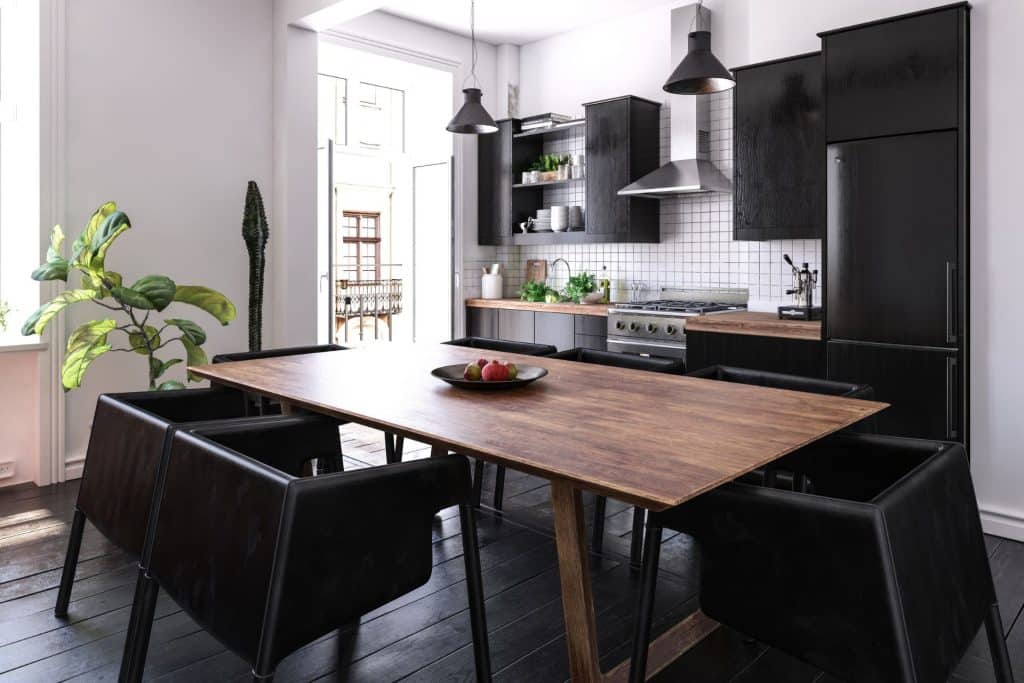
Walnut fits a modern kitchen well because it brings warmth to flat, simple doors. Ideas that work:
- Flat-panel or slab doors with no hardware. Push-to-open or integrated edge pulls keep the grain as the focus.
- Rift-cut or quarter-sawn walnut. The grain runs in tight, straight lines for a clean look.
- Walnut with white or pale uppers. Walnut base cabinets with light upper cabinets or open shelves keep the room bright.
- Walnut island, painted perimeter. Use walnut on one large piece as a feature, and paint the rest in a soft neutral, deep green or charcoal.
- Walnut with matte black or brushed brass. Both metals suit the brown tones.
- Quartz or stone with quiet movement. Let the wood carry the pattern. A plain white, cream or soft gray surface lets walnut stand out. We carry brands such as Cambria and MSI, and you can see samples on our countertops page.
For a more traditional room, a medium walnut stain with raised-panel doors, natural stone and warm metals gives a classic look. Cooler colors such as soft gray or muted blue on walls or backsplash tile balance the brown.
Walnut grain cuts and finishes
How the log is cut changes the look more than most people expect.
- Plain-sawn (flat-cut). Cathedral arches and swirling figure. It’s the most common and the most traditional-looking.
- Quarter-sawn. Straighter, tighter lines with some ribbon effect. A good match for crisp modern doors.
- Rift-cut. The straightest, most uniform lines, like the cabinets pictured above. It tends to cost more because more of the log is unused.
Walnut is rarely stained, according to The Wood Database, because its natural color is the appeal. Most walnut cabinets get a clear or lightly toned finish. That keeps the color deep and the grain visible. A matte or satin sheen looks more current than high gloss, and also hides fingerprints better.
Ask to see a finished door sample from the exact line you’re considering. Walnut varies board to board, with lighter sapwood streaks and darker heartwood, so decide in advance how much of that variation you like. Some people love it, and others want a more even look, which a good cabinet maker can match by sorting and grading the material.
Lighting and hardware
Dark wood absorbs light. Plan for it.
- Under-cabinet LED lighting on the uppers or shelves lights the counter and shows off the grain.
- Warm white bulbs (around 2700 to 3000K) suit walnut. Very cool bulbs make it look flat.
- Pick hardware that either disappears (edge pulls, push latches) or contrasts on purpose, such as brushed brass, matte black or stainless.
Are walnut cabinets expensive?
Relatively, yes. Walnut is described by The Wood Database as a premium domestic hardwood. But the species is only one part of a cabinet’s price. These factors usually matter more.
- Cabinet tier: stock, semi-custom or custom. HomeLight, citing HomeGuide, lists national ranges of $100 to $280 per linear foot (stock), $200 to $550 (semi-custom) and $500 to $1,200 (custom), in an article dated April 2021. These are third-party averages for all cabinets, not walnut-specific, and are likely out of date. Use them only to see how the tiers compare.
- Solid vs. veneer construction.
- Kitchen size and layout. More linear feet, more cost.
- Door style. Slab doors are simple. Detailed raised-panel doors cost more to build.
- Finish. A clear coat on natural walnut is different from a custom-toned finish.
- Installation and trim. Also hardware, crown, filler panels and any layout changes.
We don’t publish prices. Because walnut quotes vary so much with construction, the most useful number is a detailed written proposal for your exact kitchen. We’ll price it against another wood so you see the difference.
Ways to get the look for less
- Use walnut on an island, a range wall or open shelving, and a less expensive door elsewhere.
- Ask about walnut veneer doors instead of solid.
- Compare with other warm woods, such as cherry or stained hickory or oak, from lines we carry. See our guide to kitchen cabinet wood types.
- Consider a walnut-look finish from a manufactured line. It won’t be real wood, but it can be close from a few feet away.
How to care for walnut cabinets
- Wipe with a soft, damp cloth, then dry. Use a mild soap for grease.
- Avoid abrasive cleaners, strong chemicals and soaking the surface.
- Clean up spills near the sink and dishwasher quickly.
- Use blinds or UV film if direct sun hits the cabinets for long hours.
- Check hinges and pulls once a year and tighten them.
Always follow the finish maker’s or cabinet manufacturer’s care instructions, because they vary by finish.
Related: Kitchen cabinet wood types compared · Waypoint cabinets review
Is walnut a good choice for your kitchen?
Walnut is a good fit if:
- You like a darker, richer palette and a visible grain.
- You’re fine with a premium material in a visible place.
- You want a modern look with warmth.
Another wood may suit you better if:
- You want a bright, airy white or pale kitchen.
- You’d rather spend on layout, lighting or countertops.
- The room gets intense direct sunlight and you want the least color change.
If you can’t decide, bring photos to our kitchen cabinets showroom in Fairfax. Seeing real samples under real light settles most of these questions.
Frequently asked questions
Are walnut kitchen cabinets expensive?
They cost more than most domestic hardwoods because walnut is a premium species, though construction (solid vs. veneer), tier and layout all affect the total. Ask for a written proposal that prices the same kitchen in walnut and in another wood.
Are solid walnut cabinets worth it?
Solid walnut gives real wood on every face, but veneer walnut is also real wood and is often more stable on large flat doors. Worth it depends on your budget and style. Many contemporary kitchens use veneer for slab doors.
Do walnut cabinets darken or fade?
Wood changes color with light. The Wood Database notes walnut can fade in direct sunlight. A good finish and window treatments slow the change.
What color countertop goes with walnut cabinets?
White, cream and soft gray quartz or stone are common, because they let the wood be the feature. Dark stone also works in a moodier room. Look at samples next to your door sample.
How hard is walnut compared with maple and oak?
Black walnut is 1,010 lbf on the Janka scale. Hard maple is about 1,450 and red oak about 1,290, so walnut is somewhat softer but still suitable for cabinets.
Can you get walnut cabinets in Northern Virginia?
Yes. We design and install cabinets for kitchens across Fairfax County and nearby communities, and we show cabinets and samples at our showroom, 3204 Old Pickett Rd, Fairfax.
Plan your walnut kitchen with us
City Kitchen & Bath is a licensed and insured (Virginia Class A license 2705185680) design-build kitchen remodeler in Fairfax. Design is included, our installers are in-house, and a dedicated project manager runs your job. Book a free design consultation or call (703) 552-5252.
This post is general information. Material properties come from the sources linked above, checked November 2026.