


Short answer: In Virginia, a licensed contractor doing residential work must use a written contract, signed by both sides before work begins or any payment is taken. As we read the state’s regulation, 18VAC50-22-260, the contract has to state the start and estimated completion dates, the price, the progress payment schedule and the down payment, the materials and work, the contractor’s license details, and a notice about the Virginia Contractor Transaction Recovery Fund. Any change must be in writing and signed by both parties. Read it all before you sign, and ask questions about anything that isn’t clear.
This post is general information, not legal advice. Rules change, and your situation may be different. For legal questions about your contract, talk to a Virginia attorney or contact the Virginia Department of Professional and Occupational Regulation (DPOR).

What Virginia requires in a residential contract
The Virginia Board for Contractors, which is part of DPOR, sets contract rules for licensed contractors in 18VAC50-22-260. For residential work (single-family or multiple-family buildings, including accessory structures), the section requires a written contract. As we read it:
| What the contract must have | Why it matters to you |
|---|---|
| Signatures of both the consumer and the contractor (or agent) before work starts or payments are accepted | No work and no deposit without a signed contract |
| A fully executed copy delivered to you before work begins | You have the terms on file |
| Start date and estimated completion date | Sets expectations; delays are handled by the contract |
| Total cost, or for cost-plus contracts, the fee or percentage and a cap on the total | You know what you’re agreeing to |
| Amounts and schedule of progress payments, including a specific statement of the down payment | You see when and how much you pay |
| A list of the materials and work you requested | Defines the scope |
| A plain-language clause on events beyond the contractor’s control | Spells out how outside delays are treated |
| An assurance that the contractor will meet local requirements for permits, inspections and zoning | Permits aren’t an afterthought |
| Disclosure of each party’s cancellation rights | You know what you can do if you change your mind |
| A signed statement that you received and read DPOR’s statement of consumer protection | Confirms you got the state’s information |
| The contractor’s name, address, license number, license class and classifications or specialties | You can verify the license |
| A requirement that changes to cost, materials, work or completion date be in writing and signed by all parties | Prevents “verbal change” disputes |
| A statement that the Recovery Fund exists, with information on how to contact the Board | Tells you where to go if there’s a problem |
The regulation also makes it a violation for a contractor to fail to get written change orders signed by both sides, and it requires contractors to keep the contract, addenda and change orders for five years. The regulation text is the source of truth. Read the current version rather than relying on a summary, including ours.
Questions to ask before you sign
Use these as a list at the table. Good contractors expect them.
About the contractor
- What is your Virginia license number and class? Then verify it yourself on DPOR’s License Lookup. The license, name and address should match the contract. Ours is Virginia Class A license 2705185680. See our credentials.
- Are you licensed and insured? Ask for proof of insurance. We are licensed and insured.
- Who will actually do the work? Some companies use their own crews and others use subcontractors. At City Kitchen & Bath, our installers are in-house, and we don’t use subcontracted crews.
- Who is my point of contact? Ask for a named project manager and how to reach them.
About the scope
- Does the contract list every item? Cabinets (line, style, finish, quantity), countertops, backsplash, flooring, plumbing fixtures, lighting, appliances, hardware, paint. If it’s vague, it will be argued about later.
- What isn’t included? Common gaps: appliances, permit fees, disposal, painting, flooring, electrical upgrades, drywall repairs.
- Are drawings attached? A layout and elevations should be part of the contract or referenced in it.
- What happens if a hidden problem turns up? Older houses especially can have surprises in the walls. Ask how those are priced and approved.
About permits
- Who pulls the permits, and are they covered in the contract? The regulation calls for an assurance the contractor will meet local requirements for permits, inspections and zoning. Ask who schedules inspections. At City Kitchen & Bath, we handle permits.
- What work will be permitted? In Fairfax County, interior alterations, wall changes and new or relocated electrical, plumbing, gas and mechanical work generally need permits, per the county’s guidance. Confirm for your project.
About money
- How much is the down payment, and what is the payment schedule? The regulation requires a specific statement on the down payment and the progress payment schedule. In the section we reviewed, we did not see a maximum deposit set, so ask what the contractor asks for and why.
- Are payments tied to completed milestones? Progress payments should match work done. We use progress payments.
- What type of contract is it? A fixed total price, cost-plus (with a cap) or time and materials. The regulation requires different information for each, so ask which one this is and what the numbers mean.
- What’s the process for allowances? If the contract has a budget line for something you haven’t picked (tile, fixtures), ask what happens if your choice costs more or less.
- Do I get a lien waiver or final paperwork with the last payment? Ask how the contractor documents that suppliers and trades are paid. We didn’t verify specific Virginia lien rules for this post, so ask an attorney if you have questions.
About schedule and changes
- What are the start and estimated completion dates? Both belong in the contract. For context, a typical City Kitchen & Bath kitchen remodel is 4 to 8 weeks of construction.
- What counts as a delay beyond your control? Read the clause carefully. The regulation says it has to explain that such delays are not abandonment and are excluded from the payment and performance timeframes.
- How are changes handled? Virginia requires written change orders signed by both parties. Ask how a change order is priced and how quickly the contractor will turn one around.
- What happens if I want to cancel? The contract must disclose cancellation rights. Ask to have them explained. Sales that happen at your home can have separate consumer rules, so ask if that applies to you.
About warranty and problems
- What does the warranty cover, for how long and who handles claims? Get it in writing. We offer a 5-year workmanship warranty. Manufacturer warranties on cabinets, countertops and appliances are separate.
- How do you handle a complaint or a dispute? Ask what the process is and whether the contract includes arbitration or other terms.
Related: Licensed Kitchen Contractor in Virginia: How to Check · Kitchen Contractor Red Flags to Watch for in NoVA · Kitchen Contractor Warranty: Workmanship vs. Product
Red flags in a contract
These aren’t proof of a problem, but they’re reasons to slow down and ask:
- No written contract, or a contract offered only after you’ve paid
- A license number you can’t verify on DPOR
- Missing start and completion dates
- A scope described in a sentence or two
- A payment schedule that isn’t tied to progress
- Pressure to sign today
- Verbal promises that aren’t in the document
- Blank lines that someone will fill in later
What the Virginia Contractor Transaction Recovery Fund is
The Recovery Fund is run by DPOR. According to DPOR’s Recovery Fund page, it can help a homeowner who holds a court judgment against a licensed contractor. It is not funded by tax revenue. Licensed contractors pay the assessments that support it.
Here’s what DPOR says about eligibility and limits:
- The claimant must have been awarded a judgment in a Virginia court against a contractor licensed by the Board for Contractors.
- The judgment must be based on the contractor’s improper or dishonest conduct. DPOR says mere breach of contract doesn’t count.
- The contractor must have been licensed during the period when the conduct occurred.
- The contract must involve the claimant’s Virginia residence.
- You must show that you took all legally available steps to collect, including debtor interrogatories.
- A claim must be filed within 12 months after the judgment is final.
- State law limits a single claim to $30,000. Multiple claims against the same contractor are capped at $100,000 per biennium, and larger total claims are prorated.
- Filing a claim does not guarantee payment.
What this means in practice
The Recovery Fund is a last resort, not a first line of protection. You would need a court judgment first, and the conduct has to meet DPOR’s standard. It does not replace choosing a licensed contractor, reading the contract and keeping good records. It also does not cover a disagreement that is only a breach of contract.
Also note that the contract must tell you the fund exists and how to contact the Board. If your contract doesn’t mention it, ask why.
Details and limits can change, and DPOR’s page is the authority. Check it before relying on this summary. Again, this is not legal advice.
Keeping good records
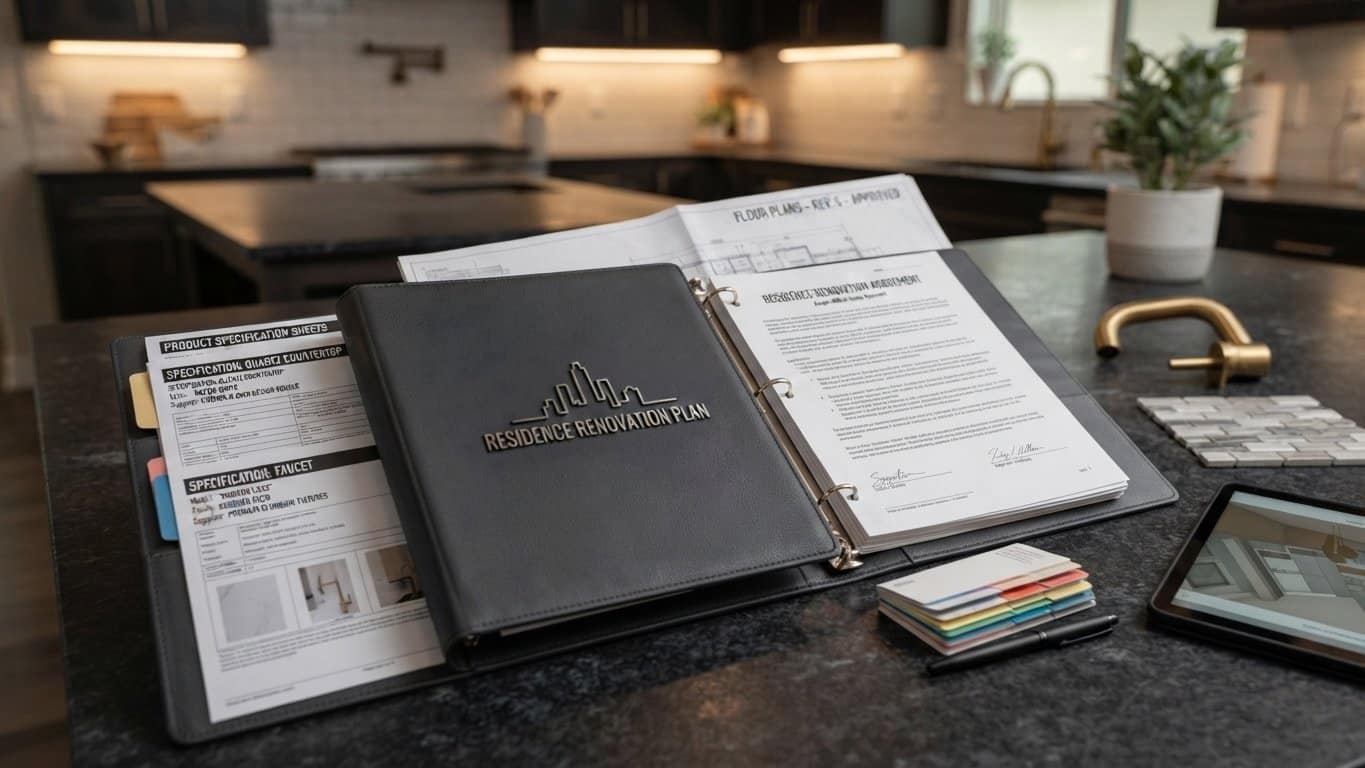
Keep a project folder, paper or digital:
- The signed contract, drawings and every addendum
- Each signed change order
- Permits and inspection sign-offs
- Proof of payment for every payment
- Product specs, model numbers and finish names
- Warranty documents
- Photos of the work before walls are closed
Contractors must keep their contract records for five years under the regulation. You should keep yours for as long as you own the house, because buyers and their inspectors often ask about permits and warranties.
How we handle it
At City Kitchen & Bath, you get design, permits and a dedicated project manager under one detailed written proposal. Our installers are in-house. Payments are progress payments. We are licensed and insured, with Virginia Class A license 2705185680, and we back our workmanship with a 5-year warranty. Our process page shows how a project moves from the first conversation to the final walkthrough.
You can book a free design consultation and bring any contract you’re considering, ours or anyone else’s. We’re happy to explain what each section means. For the full project overview, see our complete guide to kitchen remodeling in Northern Virginia or our kitchen remodeling page.
We serve homeowners in Fairfax, Fairfax City, Vienna, Oakton, Burke, Springfield, Annandale, Falls Church, McLean, Merrifield, Fairfax Station, Centreville, Chantilly and Reston. Our showroom is at 3204 Old Pickett Rd, Fairfax, VA 22031. Hours are Monday to Friday 9:00 a.m. to 5:00 p.m. and Saturday 10:00 a.m. to 4:00 p.m. We are closed Sunday. Call (703) 552-5252.
FAQ
Is a written contract required for a kitchen remodel in Virginia?
For residential work by licensed contractors, yes. Under 18VAC50-22-260, as we read it, both you and the contractor sign a written contract before work starts or payments are accepted, and you get a fully signed copy before work begins. This is general information, not legal advice.
What must a Virginia kitchen remodeling contract include?
Start and estimated completion dates, the total cost, the progress payment schedule with a specific statement of the down payment, the materials and work, a clause on events beyond the contractor’s control, permit and inspection assurances, cancellation rights, the contractor’s license details, a signed consumer-protection acknowledgment, a written-change requirement and a Recovery Fund notice.
Do change orders have to be in writing?
Yes. The regulation requires changes to cost, materials, work or completion date to be in writing and signed by all parties, and it treats failing to obtain signed written change orders as a prohibited act. Never agree to a change by phone or text alone.
What is the Virginia Contractor Transaction Recovery Fund?
It’s a DPOR program, funded by assessments on licensed contractors and not by tax revenue, that can pay certain homeowners who hold a court judgment against a licensed contractor for improper or dishonest conduct. Claims are capped at $30,000 and must be filed within 12 months after the judgment is final. It is a last resort and payment isn’t guaranteed.
How do I check that my contractor is licensed in Virginia?
Use DPOR’s License Lookup at dpor.virginia.gov. Match the name, address, license number and class on the contract against what DPOR shows. City Kitchen & Bath holds Virginia Class A license 2705185680.
How much deposit should I pay a kitchen remodeler?
The contract has to state the down payment and a progress payment schedule. In the regulation section we reviewed, no maximum deposit is set, so ask the contractor how the amount was determined and make sure later payments track completed work. We use progress payments.
